
About me
Understanding, not memorisation.
I'm Adriano G. Platania, a qualified Computer Science teacher. This site is built for anyone working through KS3, GCSE or A-Level Computer Science, and all of it is pointed at one thing: getting you to the moment the idea actually clicks, rather than the moment you can repeat it back.
The long way round
I did not arrive here from a sixth form and a teacher training course. My first qualification was a diploma in accountancy. After that came years in travel and hospitality, a lot of time spent in other people's countries, and then twentytwo years at the helm of my own companies. Running a business teaches you things a course cannot: how to hold a deadline, how to have a conversation nobody wants to have, how to read a room in the first thirty seconds.
I started my Computer Science degree in my forties, with a company to run and no sensible reason to be sitting in a first-year lecture theatre. I came out with a First. Then a Distinction at Master's level. Then a fully funded place to do doctoral research in computer vision.
I am not telling you this as a CV. I am telling you because of what it means for you. If you think you have started too late, picked the wrong subject, or already fallen too far behind to catch up, I have been all three of those things, later in life than you and with a great deal more to lose. It worked out anyway. That is the entire argument, and it is the same one on the front page of this site.
Recent qualifications, current knowledge
Because those degrees are recent, the subject I teach was learned on the technology the field actually uses now, rather than on a syllabus I last opened two decades ago. The doctoral work was in computer vision: getting machines to interpret images, which runs on the same neural network machinery behind most of what now gets called AI.
The funding for it was awarded competitively, which matters less for the money than for what it says: a panel read the proposal and decided the research was worth paying for. I left it for the classroom, and I have not regretted that. But it does mean that when a student asks what comes after A-Level, or whether a Computer Science degree is worth three years and the debt, the answer comes from having walked some of that road rather than from a prospectus.
This site is the other half of the evidence. Every visualiser, the code sandbox, and the infrastructure underneath are built with the same modern toolchain I bring into a classroom.
How I teach: the Feynman Technique
I don't believe in rote memorisation. Whether it is a Year 8 student writing their first Python loop or a Year 13 student wrestling with Two's Complement and Little Man Computer assembly, I use the Feynman Technique: break the idea down, strip out the jargon, and keep going until it is simple enough that you could teach it to someone else.
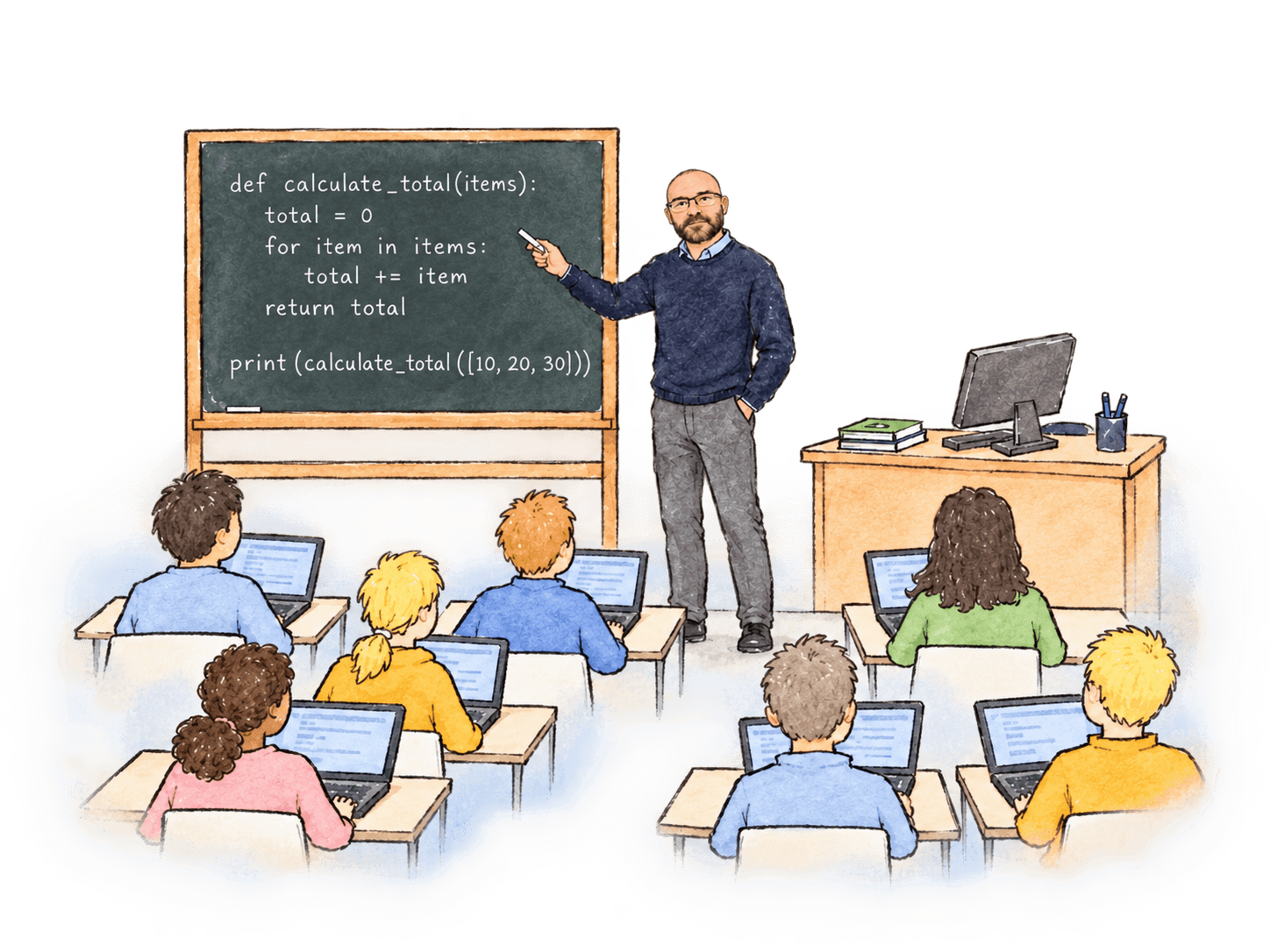
That is the principle behind every visualisation in the Lab. If you can watch bubble sort's comparisons pile up, or see the call stack grow during recursion, the exam question stops being a memory test and starts being common sense.
Every stage, one continuous path
The material here is built to span the whole route, so the same ideas reappear with more depth each time rather than starting from scratch. KS3 rides the same path rather than a strand of its own: each unit that reaches KS3 carries a KS3 note on its card saying exactly which parts belong at that stage, so Year 7 to Year 9 meet the same ideas first, at the right depth.
Where it starts. First programs, first algorithms, and the vocabulary that makes GCSE feel like a continuation rather than a jump.
Built around OCR J277. Paper 1 theory visualised topic by topic, with a Python sandbox for the Paper 2 side of it.
Every exhibit carries an A-Level toggle that opens the depth underneath, from Two's Complement to what a CPU is really doing when it fetches an instruction.
Get in touch
The quickest way to reach me is the contact form. I read every message.